Structured, completable objectives with a visible endpoint that users opt into, typically with social or competitive dimensions.
Best for
AchieverCompetitor
Context
RetentionReferral
Motivation drivers
AutonomyCompetenceRelatedness
How it works
Voluntary commitment with visible accountability
Unlike quests, challenges often have optional opt-in and social visibility. For the Competitor, time-limited challenges with ranked outcomes are the natural habitat. The opt-in nature respects user autonomy while social visibility creates ambient competitive pressure for those who choose to participate.
Core principle
Voluntary commitment with visible accountability. The user chose this goal, which makes completion more meaningful and abandonment more costly.
Watch out for
Challenges set too high alienate new users. The ideal challenge is achievable for the median user with meaningful effort. Challenges requiring subscription access before participation create resentment.
Structural variants
Four ways to build it
01
Solo challenges
02
Community challenges
03
Friend challenges
04
Branded / partner challenges
Lifecycle placement
Mid-to-late lifecycle. Strongest once the user has formed a baseline habit.
Case studies · 5
Seen in the wild
CanvaDesign
How they use it
Design School course activities function as opt-in structured objectives with defined completion states and rewards. The certification quiz, AI Skills for Students, has 14 questions, a 30-minute window, a pass/fail outcome, and a named reward (First Certificate badge plus a downloadable certificate). Entry is voluntary; during analysis the user chose to take the quiz without completing the full course first. Individual Design School courses are described with duration, difficulty level, lesson count, and whether they carry a shareable certificate.
Why it works
The challenge and achievement mechanics are inseparable at the point of completion, finishing a quiz always produces both a certificate (external credential) and a badge (in-app achievement). The same completion action serves both the internal achievement system and the professional social network.
The detail
Challenges sit within Design School's course catalogue, filterable by topic, difficulty, and certificate availability. Some courses are free, some are premium (marked with a crown). Each course page shows the prerequisite knowledge level and whether a certificate is awarded.
Takeaway
Every Design School quiz that carries a certificate produces both a shareable certificate and an in-app badge, the same completion action serves both the internal achievement system and the external social network.
Three challenges were observed in the dedicated Challenges tab. Challenge 1 (Hosting Countries): collect 2 stickers from each host country, reward: official mascots sticker, expired. Challenge 2 (2022 FIFA World Cup winner team): collect 5 stickers of the winning team, reward: digital power pack, expired. Challenge 3 (Team Captains): collect 10 team captains, reward: Panini logo sticker, 2 days remaining. A 'participate in this challenge' opt-in button changes to 'you are already participating' after tapping. Stickers only count toward a challenge if glued into the album.
Why it works
The opt-in structure with a visible endpoint and a defined reward creates the defining features of the challenges mechanic, voluntary commitment, visible accountability, concrete goal. The album-gluing requirement adds an intermediate step that reinforces the core collection loop.
The detail
Challenges are in a dedicated tab in the bottom navigation. Each challenge shows reward, task description, progress counter, remaining time, and a participate status. Challenges are not accessible to guest accounts.
Takeaway
Two of three visible challenges had already expired at time of analysis, with no explanation of cycle cadence, suggesting calendar-based challenges tied to real-world events rather than recurring weekly resets.
screenshot
Challenge 3 "Team Captains" screen showing the reward (Panini logo sticker), 0/10 progress, 2-day timer, and "participate in this challenge" button
Challenges are framed as self-set goals during onboarding: the user chooses 3, 5, 7, or 10 consecutive practice days, with labels (Good / Great / Amazing / Incredible). The recommended default is 5 days. After the first session, the 'I'm committed' button explicitly asks the user to affirm their chosen goal. Challenge archive access is gated behind the Plus subscription.
Why it works
Framing the challenge as a user-set goal rather than an app-imposed task shifts psychological ownership. The 'I'm committed' button reinforces the user's own stated commitment rather than making a new demand. The challenge cadence (3–10 days) is calibrated to produce a first milestone within the first week of use.
The detail
The goal-setting screen during onboarding presents the challenge as a commitment the user makes before their first session. Progress displays as 'Day 1 of 10' on the home screen. Post-session, the 'Can you make it to a two day streak?' screen reinforces the challenge framing.
Takeaway
The goal-setting during onboarding frames the challenge as a self-made commitment, 'I want to practice 10 consecutive days' is a user declaration, not an app requirement.
screenshot
Dopamine Rebalance Challenge page showing the 10-day structure with day-by-day teacher breakdown, 165,000 joined count, and the participant location map
Challenges are the central community engagement mechanic, accessible via the cup icon in the bottom navigation bar. Three active challenges ran simultaneously during analysis: Bring in the Animals (4 days, 50 credits prize), Leaf and Lady (active), and My Favorite View (4 days 12 hours, winner's gallery prize). Each challenge has a countdown timer, submission rules, a scrollable submissions gallery, and a voting tab. Individual community spaces can also create their own challenges, running a dual-scale system, platform-wide and community-specific simultaneously.
Why it works
Two reward types ran simultaneously: credits for Bring in the Animals, and gallery feature for My Favorite View. The gallery placement is a social recognition reward rather than a currency reward, making participation motivating for users who wouldn't use credits but value visibility. The dual-scale challenge infrastructure, where any space owner can run their own competition, creates a long tail of community-specific challenges below the platform-level events.
The detail
The Challenges tab uses the cup icon in the primary navigation. Challenge history shows past results by place (1st through 10th) with profile links to winners. Voting is possible on multiple submissions simultaneously, and vote counts are not visible to voters during the active window.
Takeaway
92 submissions were visible for My Favorite View during analysis, the submission gallery functions as a browsable content feed, creating engagement beyond the creation and voting actions.
screenshot
Challenges tab showing three active challenges with countdown timers (4 days, 4 days 12hrs), prizes (50 credits, winner's gallery), and active submission counts
screenshot
My Favorite View challenge page showing the About section, rules, and the 92-submission scrollable gallery with follow buttons on creator profiles
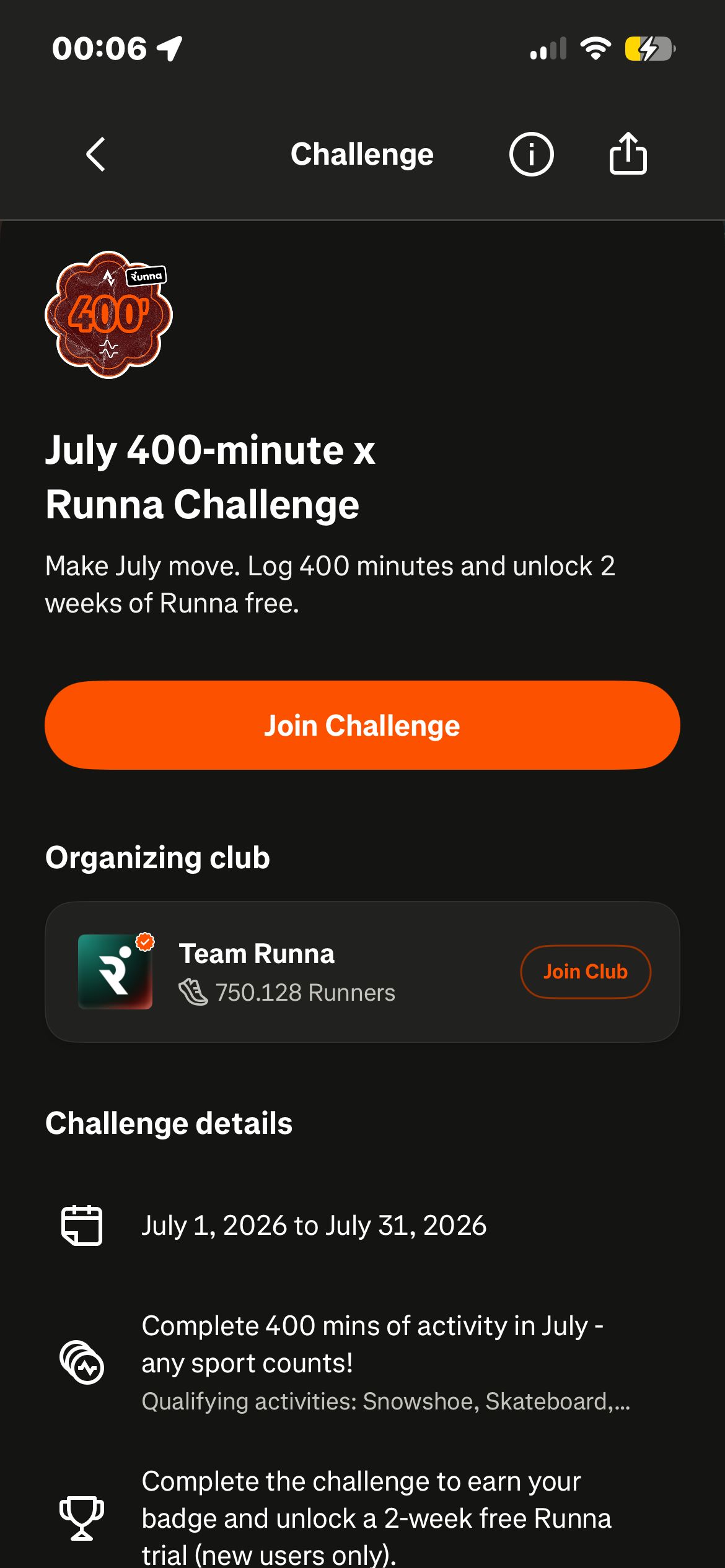
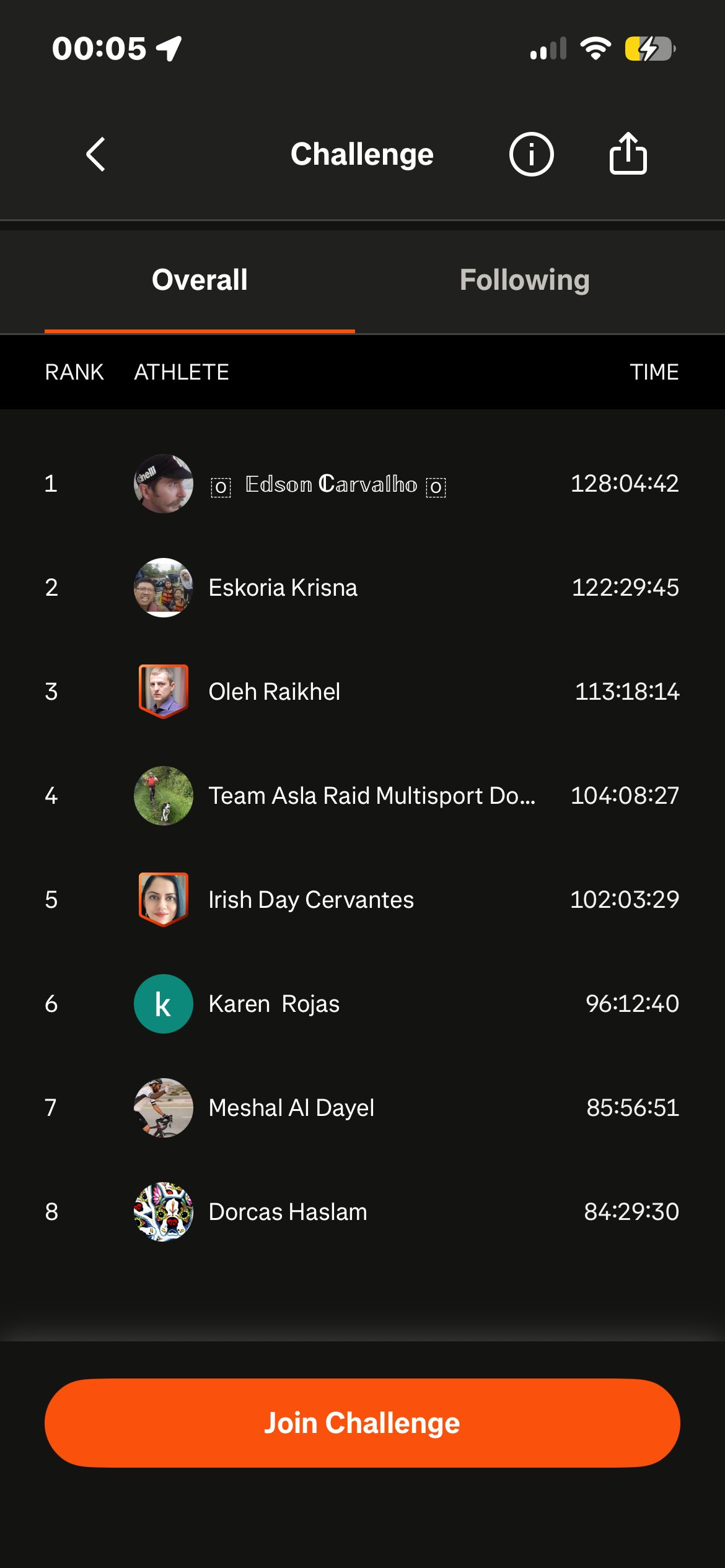
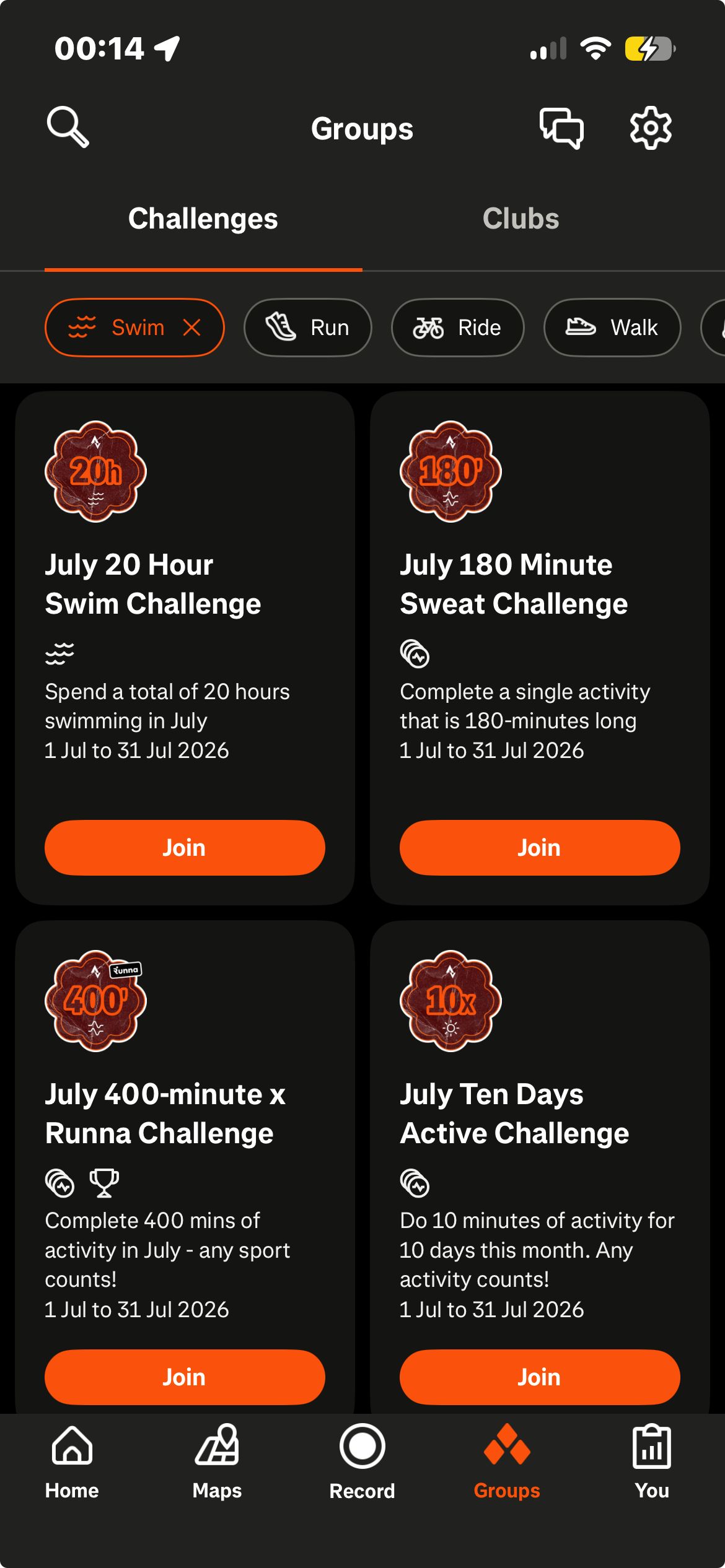
Challenges are opt-in monthly or multi-week structured objectives visible to followers and the broader Strava community. Each challenge shows a target, a deadline, a participant count, and a join button. On completion, a digital trophy is awarded and displayed on the user's profile trophy case. Partner-branded challenges add external rewards, a completion trophy carrying a brand name, or an in-app reward like a free trial of a partner service.
Why it works
The participant count is load-bearing. A challenge showing over one million athletes already joined communicates scale that makes opting in feel consequential without requiring the user to know any of the other participants. Activity-type filtering ensures a cyclist and a swimmer see separate relevant challenge sets from the same entry point.
The detail
Challenges live in the Groups tab under a dedicated Challenges sub-tab, filtered by the user's logged activity types. Joining requires one tap. After completing the first activity in a session, a challenge progress update appears. Group challenge creation is gated to subscribers, free users can join but cannot create club challenges.
Takeaway
Partner challenges function as paid distribution for sponsors, brands run branded challenges and completion rewards users with digital trophies carrying the brand name.
Each week we add three fresh breakdowns of how successful apps implement game mechanics. Get the most interesting mechanics from each, straight into your inbox.